Skip to content
Osteopathy · Sciatica Officer

Sciatica
Officer.

Officer's closest osteopath for sciatica — evidence-based care just minutes away in Berwick.

Last reviewed: May 2025

Officer splits neatly into two groups when it comes to sciatica, and they arrive with almost opposite stories. The trades workforce building out the Arena estate and the surrounding developments get it from lifting — a specific moment on site, usually bending and twisting under load. The M1 commuters get it from sitting: an hour each way in a car seat compresses the lumbar discs and irritates the nerve gradually, with no incident to point at. We're five minutes down the Princes Freeway, and the distinction matters because sitting-driven and lifting-driven sciatica need different early management.

For a full explanation of what causes sciatica, how the different presentations are told apart, and what recovery usually looks like, read our complete guide to sciatica.

Common causes
Lumbar disc herniation from lifting
The classic site injury: bending and rotating under load pushes disc material against the nerve root, sending pain, tingling, or numbness down the leg. Onset is usually sudden and traceable to one lift, and it is typically much worse with sitting and forward bending afterwards.
Sustained sitting and commuter disc load
Long freeway commutes hold the lumbar spine in flexion for hours, raising pressure on the discs continuously. This version builds gradually with no memorable trigger, and people often notice the leg symptoms in the car well before they notice any back pain at all.
Piriformis compressionRead more →
The sciatic nerve passes near or through the piriformis muscle in the buttock. Prolonged sitting — especially on a wallet or a hard seat — irritates it, and the resulting symptoms mimic disc-related sciatica closely while needing a different approach.
Lumbar facet joint compression
Inflamed or stiff lumbar facet joints refer pain into the buttock and leg in patterns that resemble nerve irritation. More common in the overhead and extension-heavy trades work than in the commuter group.
Spinal stenosis
Narrowing of the spinal canal, more common with age, compressing the nerve roots and producing leg pain and heaviness that worsens with walking and eases when you sit or lean forward — the reverse of the disc pattern.
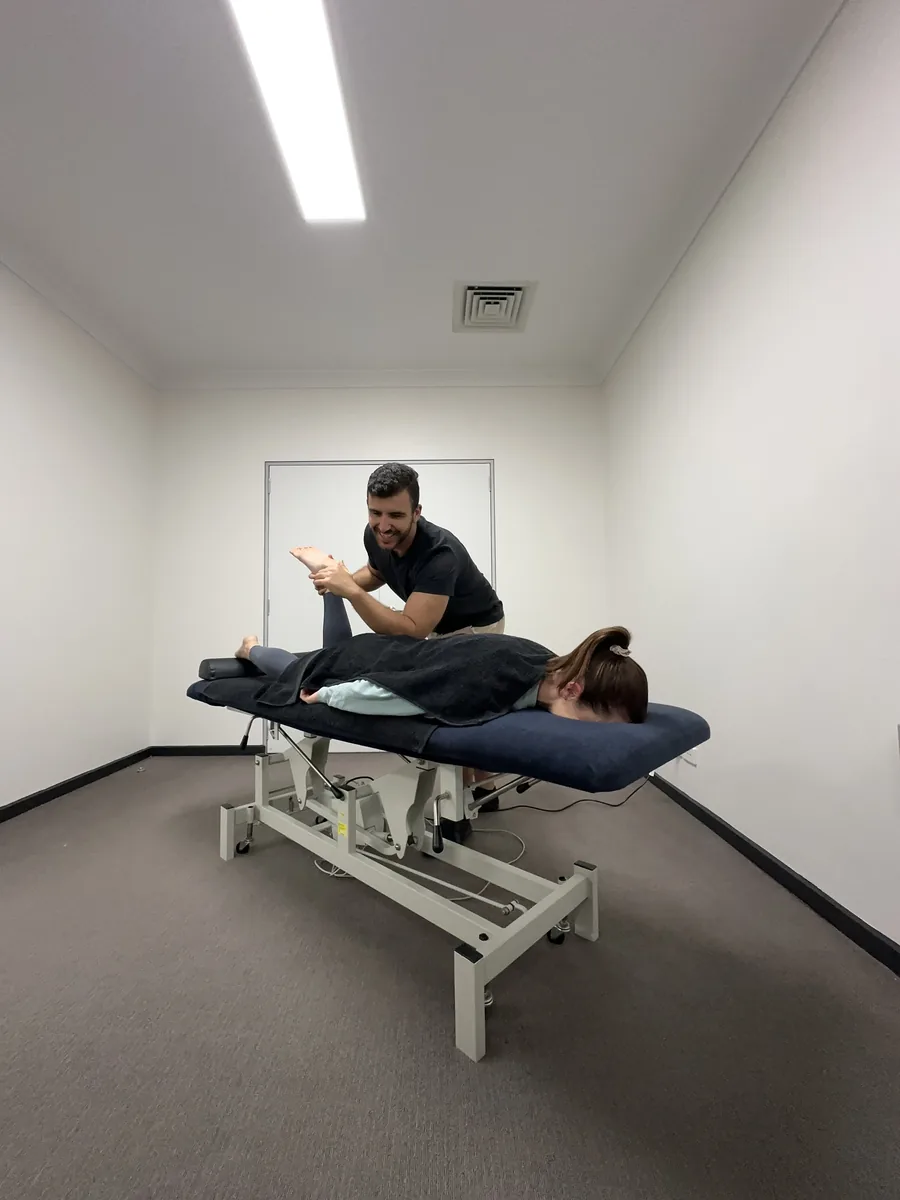
Osteopath Steven Eskaf mobilising a patient’s hip and knee while they lie face down on the treatment table
Hands-on treatment at RISE Sports & Spinal, Berwick.
How we treat it

We assess lumbar mobility, neurological signs, and the likely compression point — disc, joint, or soft tissue — because the management diverges sharply from there. For the lifting-driven presentations we work on the mechanics that caused it, so returning to site does not simply re-trigger it. For commuters, seat angle, lumbar support and how often you break up the drive remove a large slice of the daily load for no ongoing effort. Treatment combines joint mobilisation to reduce compressive load, soft tissue release through the piriformis and deep hip rotators, neural mobilisation to desensitise the nerve, and progressive loading to rebuild tolerance. Most acute episodes respond well within 4–6 sessions.

Ready to get started?

Same-week appointments available. Initial consult 60 min · $149 · HICAPS on-site.

Common questions

FAQ: sciatica officer

How far is your clinic from Officer?
We're at 5/6-8 Langmore Lane, Berwick — approximately 5 minutes from Officer and the Arena estate via the Princes Freeway.
My leg pain is worst in the car. Why?
Sitting raises pressure inside the lumbar discs more than standing does, and a long commute holds that load for an hour at a stretch. If your sciatica peaks during or just after driving, the disc is the most likely driver — and seat setup plus regular breaks are genuinely part of the treatment, not an afterthought.
I lift on site all day. Can I keep working?
Often yes, with modification — and we'll be specific about which movements to change rather than telling you to rest, which usually isn't an option. If there's progressive weakness in the leg we'll say so clearly, because that's the situation where continuing to load it is genuinely unwise.
When is sciatica an emergency?
Go to an emergency department rather than booking with us if you develop numbness around the groin or inner thighs, loss of bladder or bowel control, or rapidly worsening weakness in both legs. These are rare but time-critical. A suddenly dropping foot also needs same-day medical assessment.
Do I need an MRI before coming in?
Usually not. Most sciatica responds to conservative care regardless of what imaging shows, and disc bulges appear routinely in people with no symptoms. We'll advise if a scan would genuinely change the management plan.
Do I need a referral?
No. Book directly online. DVA, WorkCover, and Medicare EPC referrals are also welcome — WorkCover is common among our Officer trades patients.

Seen enough?
Let's fix it.

Book an initial assessment in Berwick. Same-week availability most weeks.

Same-week appointments availableCall

Tweaks