Skip to content
Osteopathy · Sciatica

Sciatica
& leg pain.

Leg pain, nerve pain, or pins and needles — there's a reason for it.

Last reviewed: May 2025

Sciatica describes pain, numbness, or tingling that travels from the lower back or buttock into the leg, following the path of the sciatic nerve. It is a symptom, not a diagnosis — the useful question is never simply "do I have sciatica", but where along the nerve the irritation is happening and what is causing it. This page covers the common causes, how each one presents differently, what treatment involves, and how long recovery usually takes. If you are looking for treatment near you, the suburb links further down go to local pages for Berwick, Narre Warren, Cranbourne, Clyde, Pakenham, Officer and Beaconsfield.

Common causes
Lumbar disc herniationRead more →
A bulging or herniated disc pressing on a lumbar nerve root, most often at L4/L5 or L5/S1. This is the cause most people assume they have, and it does account for a large share of true sciatica. It typically produces pain in a specific, traceable band down the leg — often below the knee — and is usually worse with sitting, coughing, sneezing, and bending forward. Symptoms frequently ease with standing or walking.
Piriformis compressionRead more →
The sciatic nerve runs beneath — and in some people directly through — the piriformis muscle deep in the buttock. When that muscle is tight or in spasm it can compress the nerve and produce symptoms almost identical to a disc problem. The distinguishing features are usually a deep, focal ache in the buttock, aggravation from prolonged sitting on a hard surface or driving, and an absence of the forward-bending aggravation that characterises disc-related pain. It responds to a completely different treatment approach, which is why the distinction matters.
Lumbar joint compression and foraminal stenosisRead more →
Facet joint inflammation or narrowing of the foramen — the bony opening the nerve root exits through — can irritate the nerve without any disc involvement at all. This pattern is more common with extension than flexion: worse with standing, walking, and arching backwards, and often relieved by sitting or leaning forward onto a trolley. It becomes more prevalent with age.
Gluteal and hip referred painRead more →
Not all leg pain is nerve pain. Trigger points and dysfunction in the gluteal muscles, and pathology at the hip joint itself, produce referral patterns that mimic sciatica closely. The tell is usually that the pain stops at or above the knee, and does not come with genuine neurological signs — no numbness, no pins and needles, no weakness. This is treatable, but treating it as a disc problem will not work.
Sacroiliac joint dysfunction
The SIJ refers pain into the buttock and posterior thigh in a pattern regularly mistaken for sciatica. It is common after pregnancy, following a fall onto one side, and in people with a marked leg-length difference or asymmetric loading habits. Orthopaedic testing separates it from true nerve-root involvement reasonably reliably.
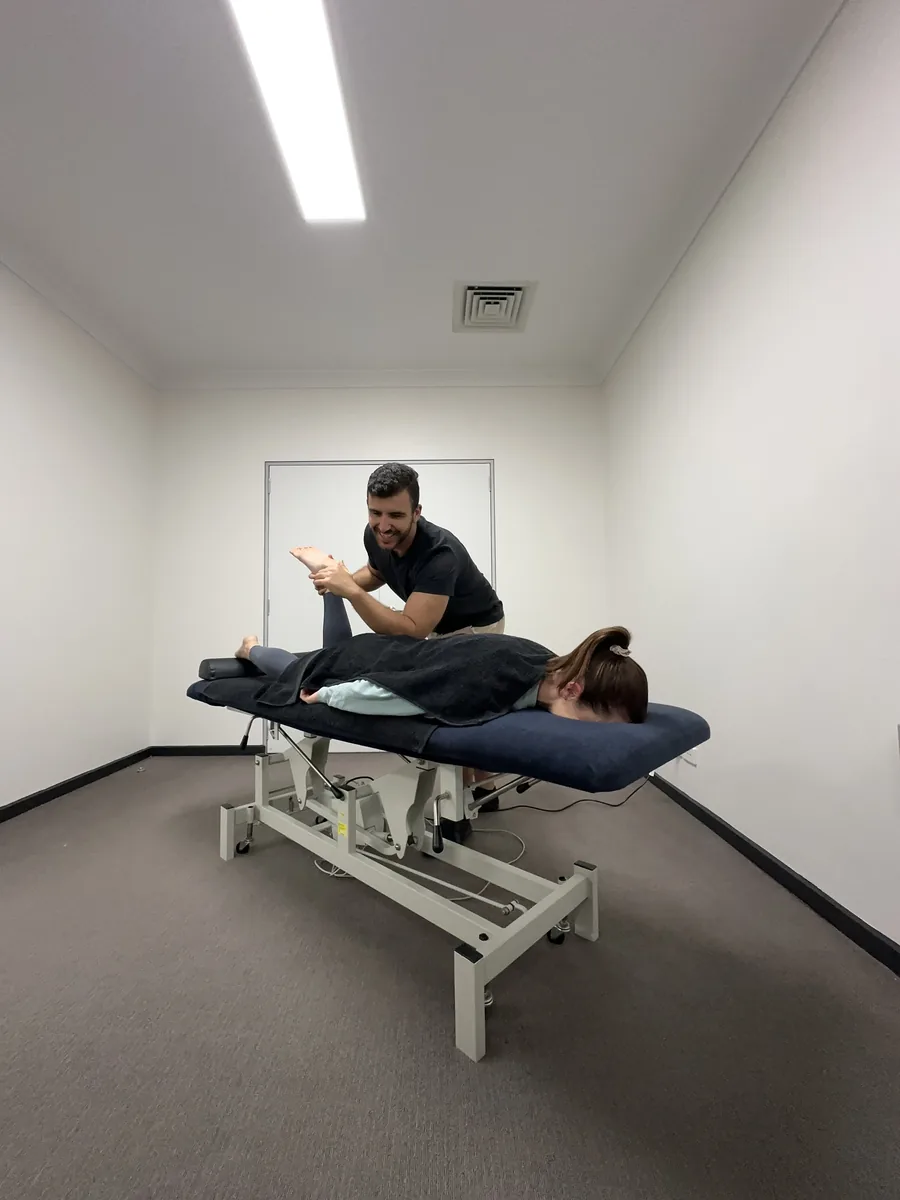
Osteopath Steven Eskaf mobilising a patient’s hip and knee while they lie face down on the treatment table
Hands-on treatment at RISE Sports & Spinal, Berwick.
How we treat it

Assessment comes first, because the five causes above need genuinely different treatment. We use orthopaedic testing, neurological screening, and movement assessment to work out where the nerve is being irritated — a straight-leg-raise and slump test to implicate the nerve root, resisted and positional testing to separate piriformis from disc, extension-based loading to identify a stenotic pattern, and SIJ provocation testing where the picture points that way. Treatment then targets what we actually found: lumbar mobilisation and directional preference work for disc-driven presentations, soft tissue release and specific stretching for piriformis compression, and flexion-biased loading for stenotic pain. Across all of them we add neural mobilisation to desensitise the nerve and progressive loading to rebuild tolerance, because settling the flare without restoring capacity is how sciatica becomes recurrent. Mild-to-moderate cases typically improve meaningfully within 4–6 sessions; severe or long-standing presentations take longer, but the direction of travel is usually clear within the first two or three.

Ready to get started?

Same-week appointments available. Initial consult 60 min · $149 · HICAPS on-site.

Common questions

FAQ: sciatica

Is it always a disc?
No — and assuming so is the most common mistake. Piriformis compression, facet joint and foraminal narrowing, SIJ dysfunction, and gluteal referral are all common enough that accurate assessment has to come before treatment. The treatment for a disc-driven presentation can actively aggravate a stenotic one, so getting this right at the outset matters more than starting fast.
How do I know if it is really sciatica or just back pain?
True sciatica travels below the knee and usually brings genuine neurological symptoms with it — tingling, numbness, or weakness. Pain that stops in the buttock or thigh, with no neurological signs, is more likely referred pain from muscle or joint. Both are very treatable, but they are different problems with different treatment.
Do I need an MRI before starting treatment?
Usually not. Most sciatica improves with conservative care regardless of what a scan shows, and imaging findings correlate poorly with symptoms — disc bulges appear routinely in people with no pain at all. A scan is worth doing when it would genuinely change the plan: progressive weakness, symptoms that are not responding as expected, or when specialist referral is being considered. We will tell you clearly if we think you have reached that point.
When is sciatica an emergency?
Go to an emergency department rather than booking with us if you develop numbness in the saddle region (inner thighs, groin, buttocks), loss of bladder or bowel control, or rapidly progressing weakness in both legs. These can indicate cauda equina syndrome, which is rare but time-critical. Sudden severe weakness in one leg, such as a foot that drops, also warrants same-day medical assessment.
Will I need surgery?
Very probably not. The large majority of sciatica resolves with conservative care, and even sizeable disc herniations frequently resorb on their own over months. Surgery is reserved for cases with progressive neurological deficit, cauda equina signs, or genuinely intractable pain after conservative management has been given a fair run.
Can I exercise with sciatica?
Yes — the right kind, and usually sooner than people expect. Complete rest tends to prolong the problem. Which movements help depends entirely on the cause: flexion-based loading often eases a stenotic presentation and aggravates a disc, while the reverse is true for many disc-driven cases. That is precisely why the exercises need to follow the assessment rather than come off a generic handout.
How long does sciatica take to settle?
Mild-to-moderate cases usually improve substantially within 4–6 sessions across roughly four to six weeks. Long-standing or severe presentations take longer, and true disc herniations with strong neurological signs can take several months to fully resolve. You should see a clear trajectory early, though — if there is no meaningful change after a few sessions, that is a signal to reassess rather than continue.

Seen enough?
Let's fix it.

Book an initial assessment in Berwick. Same-week availability most weeks.

Same-week appointments availableCall

Tweaks