
Services · Dry Needling
Release the
trigger point.
Fine-needle therapy targeting tight, painful muscle trigger points. Drug-free, precise, and highly effective for stubborn muscular pain.
What is dry needling?
Targeting the
source of tension.
Dry needling uses fine acupuncture-gauge needles inserted directly into trigger points -- tight, knotted bands within a muscle that cause local pain or refer pain to other areas. The needle stimulates a twitch response, releasing the contraction and restoring normal muscle function.
Unlike acupuncture, dry needling is rooted in Western anatomy and neuroscience. It targets specific musculoskeletal structures identified through clinical assessment -- not meridian lines.
Increases local blood flow
The needle triggers a local inflammatory response that brings fresh blood and nutrients to the area.
Reduces muscle hypertonicity
The twitch response resets the neuromuscular junction and reduces excessive muscle tone.
Desensitises pain pathways
Repeated needle stimulus down-regulates peripheral and central sensitisation in chronic pain states.
Restores movement
With the trigger point deactivated, range of motion improves and pain with movement reduces.
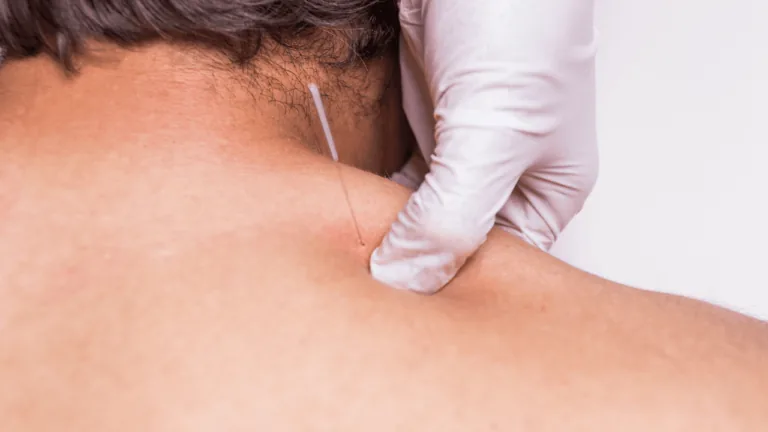 Dry needling treatment for trigger point pain relief, Berwick
When it helps
Conditions we treat
with dry needling.
+Back & neck pain
Paraspinal trigger points are one of the most common drivers of chronic low back and neck pain. Dry needling can break the pain-spasm-pain cycle quickly.
+Shoulder & rotator cuff
Infraspinatus and supraspinatus trigger points commonly refer pain into the shoulder and upper arm. Needling alongside manual therapy accelerates recovery.
+Tennis & golfer's elbow
Forearm extensor and flexor trigger points perpetuate lateral and medial elbow pain. Dry needling deactivates these and reduces tendon overload.
+Hamstrings & hip flexors
Tight, overloaded posterior chain muscles respond well to needling -- particularly in runners and cyclists with chronic tightness that won't release with stretching alone.
+Shin splints & calf pain
Tibialis anterior and posterior, gastrocnemius, and soleus trigger points are common in runners. Needling reduces the muscular load on the tibia and calf complex.
+Fibromyalgia & chronic pain
Dry needling is used adjunctively for widespread myofascial pain. It doesn't cure fibromyalgia but can significantly reduce trigger point-driven pain and improve sleep.
Before you book
What to expect
from a session.
During the session
You'll feel a dull ache, pressure, or a brief twitch when the needle contacts the trigger point. This is the target response. The needle stays in for a short period (typically 10–30 seconds) before being removed or repositioned.
After the session
Some post-needling muscle soreness is normal for 24–48 hours -- similar to a deep massage. The area may feel bruised. This is a normal inflammatory response and usually resolves quickly.
Contraindications
Dry needling is not used over blood-thinning medications without caution, over infections, on pregnant patients in certain areas, or for needle-phobic patients. Steven will screen for these before recommending it.
Dry needling is included in your standard osteopathy appointment when clinically indicated.