Pain down the leg: what the location tells you
'Sciatica' gets used for almost any pain down the leg. In reality, where the pain runs, back, side, front or inner thigh, and how far it goes, gives useful clues about where it's coming from.
When is leg pain an emergency?
Go to an emergency department straight away for new difficulty controlling your bladder or bowels, numbness around the groin or inner thighs, or weakness or numbness in both legs. See your GP promptly if weakness in your leg or foot is getting worse. Seek same-day care for a calf that is swollen, warm, red or tender, which can be a blood clot, and call 000 if that comes with chest pain or breathlessness. A leg that is suddenly cold, pale and painful is also an emergency.
What causes pain down the back of the leg?
This is the classic sciatica pattern. Pain running from the buttock down the back of the thigh and calf to the foot, often with pins and needles or numbness, usually comes from a nerve root irritated in the lower back. If it stops above the knee, it may be referred pain from the joints and muscles of the back or buttock, or a hamstring problem.
See our posts on sciatica and referred pain from the lower back.
What causes pain down the outside of the leg?
Pain from the outside of the hip down the outer thigh, usually stopping at the knee, often comes from the gluteal tendons at the side of the hip, and is worse lying on that side. Pain that continues down the outer shin to the top of the foot and big toe points to a nerve root in the lower back. A burning, numb patch on the outer thigh with no weakness is typical of a compressed skin nerve at the front of the hip, called meralgia paresthetica, which a Cochrane review notes often improves without intervention (Khalil et al., Cochrane, 2012).
See our posts on gluteal tendinopathy and meralgia paresthetica.
What causes pain down the front of the leg?
Pain in the groin and front of the thigh, sometimes reaching the knee, is the typical pattern of the hip joint. A nerve root higher in the lumbar spine can also cause front-of-thigh pain, often with weakness of the thigh muscle or a reduced knee reflex. Pain at the front of the shin in runners is usually a bone or muscle load problem.
See our post on shin splints.
How can I tell if it's my hip or my back?
A study of patients with leg pain found that a limp, groin pain and limited inward rotation of the hip were the signs that best predicted a hip problem over a spine problem (Brown et al., Clinical Orthopaedics and Related Research, 2004).
See our post on telling hip pain from back pain.
What causes pain down the inner thigh?
Most often the adductor muscles or the hip joint. A nerve root in the upper lumbar spine can refer there too. Groin pain with a lump or pain on coughing can be a hernia.
What does it mean if the pain goes below the knee?
Pain travelling below the knee into the shin, calf or foot, particularly with pins and needles or numbness, makes a nerve root more likely. Referred pain from joints and muscles usually stays above the knee.
What do pins and needles or numbness add?
They suggest a nerve is involved. The part of the foot affected helps identify which one: the top of the foot and big toe for one nerve root, the outer edge and little toes for another. Numbness in both feet points towards a general nerve problem that needs a GP.
See our post on pins and needles in the feet.
What if the pain comes on with walking and eases with rest?
Two main causes. Spinal stenosis causes leg pain or heaviness with walking and standing that eases with sitting or bending forward. Reduced blood flow to the legs causes calf cramping after a set distance that eases within minutes of stopping, even standing still. Both need assessment.
See our post on spinal stenosis.
Can muscles and tendons cause leg pain that feels like a nerve?
Yes. Hamstring and calf strains, tendon problems at the sit bone, and tight, overworked muscles can all cause pain along the leg. They're usually tender to press and provoked by using the muscle, without tingling or numbness.
Do I need a scan?
Not usually at first. Most leg pain can be worked out from the history and examination. Scans are used when there's significant or worsening weakness, when symptoms aren't improving after several weeks, or when a specific procedure is being considered.
How can an osteopath help?
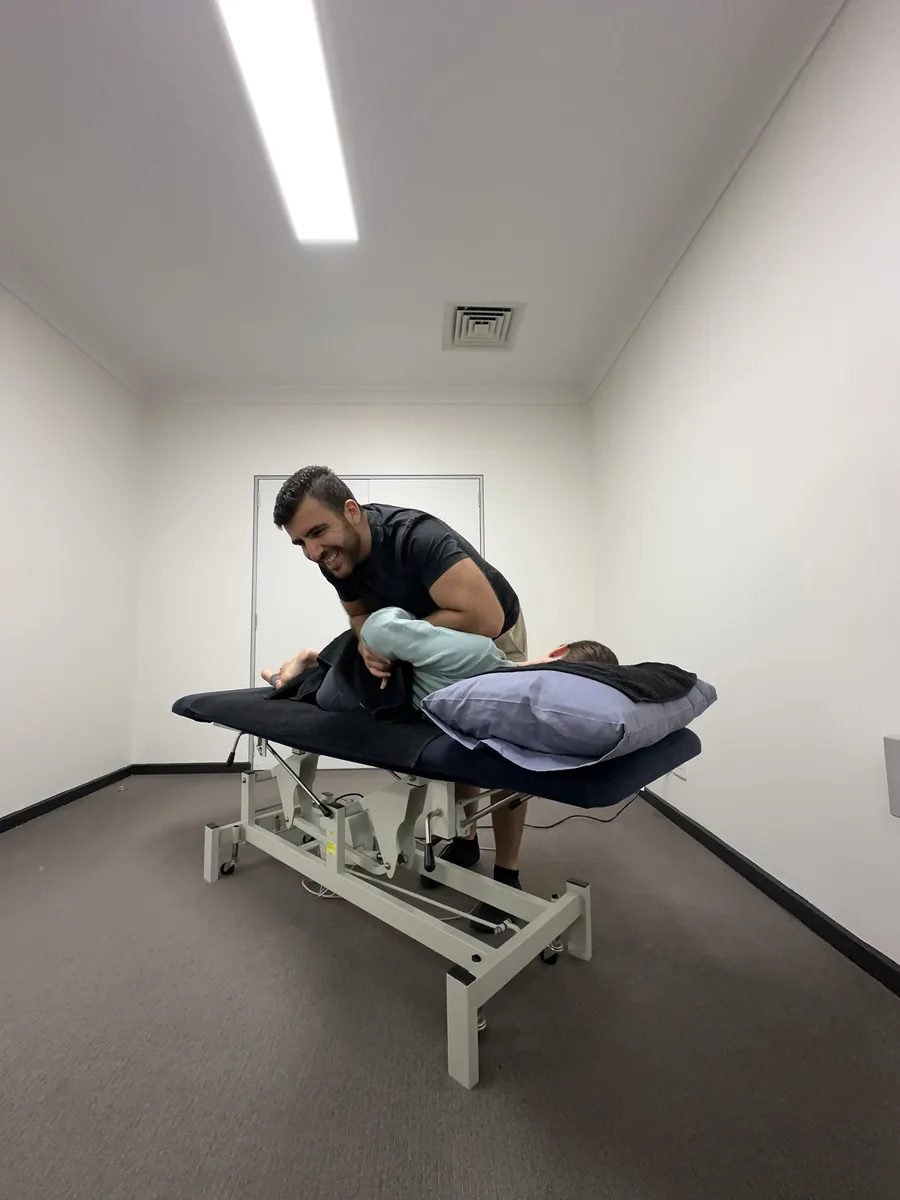
We map where your pain and any numbness run, test reflexes, strength and sensation, examine the back, hip and leg, and identify the source. Treatment is then matched to the cause, and we refer you when the pattern suggests circulation, a clot or another medical problem.
See our sciatica treatment in Berwick page. Book an assessment at our Berwick clinic. A 60-minute initial consultation is $149, with no referral needed and HICAPS on-site.
Sources
Book an initial consultation at RISE Sports & Spinal in Berwick. Clear diagnosis, hands-on treatment, and a plan that actually gets you better.
Related articles