Can an osteopath help a bulging disc?
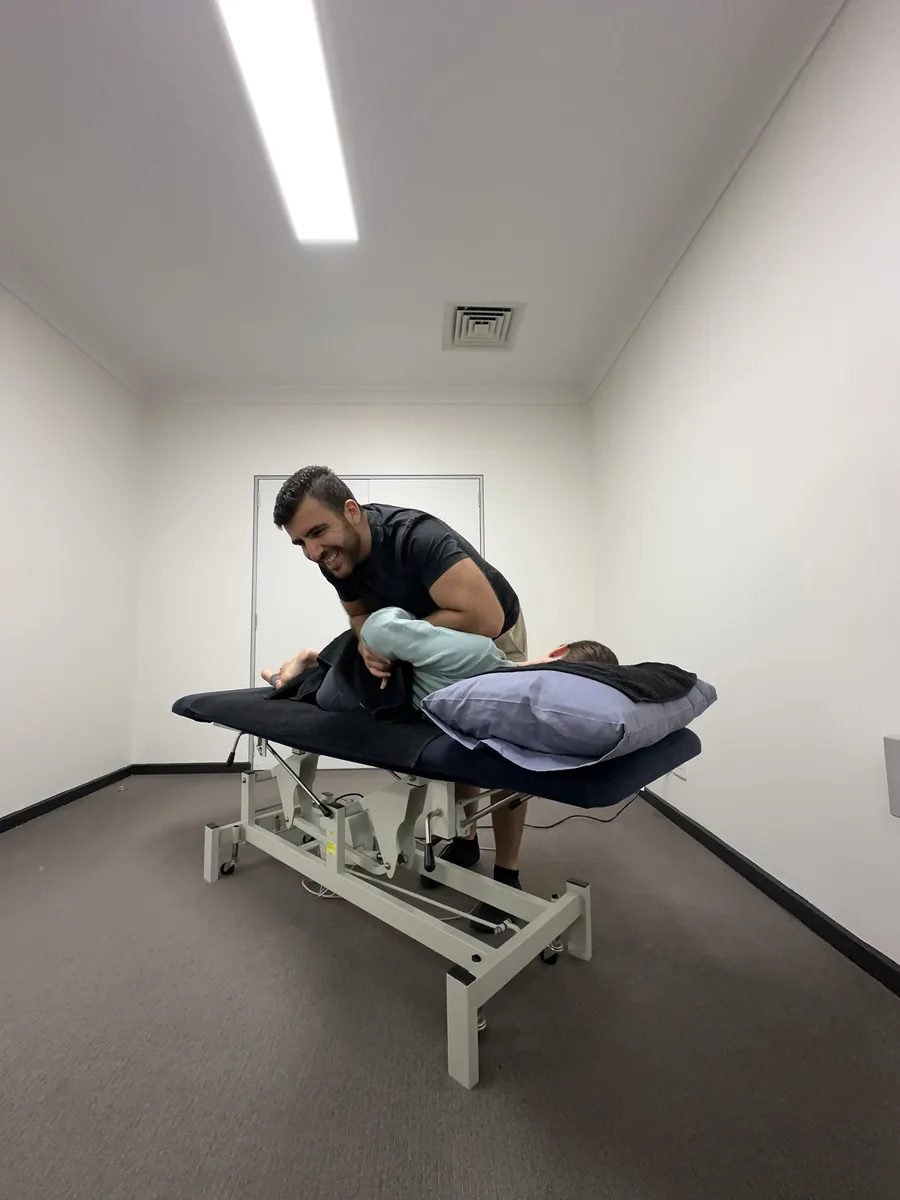
"Bulging disc" is one of the most worrying phrases people read on a scan report, and one of the most common reasons people search for help. The short answer is yes, an osteopath can help most people with a bulging disc. Here's how, and what's worth knowing first.
Is a bulging disc serious?
Usually not. Disc bulges are extremely common in people with no pain at all. A review of imaging studies in people without back pain found disc bulges in 30% of 20-year-olds, rising to 84% of 80-year-olds (Brinjikji et al., American Journal of Neuroradiology, 2015). The authors concluded that many of these findings are likely part of normal ageing. So a bulge on your scan doesn't necessarily explain your pain, and it doesn't mean your spine is damaged.
Can a bulging or herniated disc heal on its own?
Often, yes. A systematic review found that herniated disc material commonly shrinks over time without surgery, and the larger herniations were actually the most likely to regress: 96% of sequestrations and 70% of extrusions showed some regression, compared with 41% of protrusions and 13% of bulges (Chiu et al., Clinical Rehabilitation, 2015). Just as importantly, symptoms often settle even when a bulge doesn't change much on a scan.
How does an osteopath treat a bulging disc?
First, we work out whether a disc is likely to be the main source of your pain, and whether a nerve is irritated. That means a thorough history and a physical and neurological examination: reflexes, strength, sensation and nerve tension tests. Treatment then usually combines gentle hands-on treatment to ease pain and muscle guarding, movement strategies to calm the irritated area, a graded exercise program to rebuild strength and confidence, and advice on staying active and working or training around it.
We don't claim to push a disc back into place; that isn't how discs work. The aim is to settle symptoms and help your back tolerate load again.
Is osteopathy or surgery better for a disc herniation?
For most people, conservative care comes first. A meta-analysis comparing surgery with physical activity for sciatica from a disc herniation found surgery gave faster relief in the short term, but longer term there was no significant difference in leg or back pain between the two (Fernandez et al., European Spine Journal, 2016). Surgery is a reasonable option if pain is severe and not improving after several weeks, or if there's significant or worsening nerve weakness, and we'll refer you when that's the case.
What's the difference between a bulging, protruding and herniated disc?
These terms describe how far disc material extends beyond its normal boundary. A bulge is a broad, shallow extension around much of the disc's edge, and is very common with age. A protrusion is a more localised bulge where the outer wall is still largely intact. A herniation (sometimes called an extrusion or, if a fragment separates, a sequestration) is where inner disc material has pushed further out. The words sound progressively worse, but the size of the finding on a scan often doesn't match how much pain someone has. What matters most is your symptoms and what we find on examination.
What does disc pain feel like?
Disc-related back pain is often a deep ache across the lower back that's worse with sitting, bending, lifting, coughing or sneezing, and stiff first thing in the morning. If the disc is irritating a nerve root, you may also get pain travelling into the buttock or down the leg, sometimes below the knee, often with pins and needles, numbness or a feeling of weakness. Leg pain is frequently worse than the back pain itself.
Can I keep going to the gym with a bulging disc?
Usually yes, with changes. Staying active tends to help recovery more than rest. While it's sore, reduce the load and range on lifts that provoke symptoms, such as heavy deadlifts, bent-over rows and deep loaded squats, and swap to variations your back tolerates, such as trap-bar or block pulls, goblet squats, machines and carries. Walking, bridges and trunk exercises are usually well tolerated. The rule of thumb is that symptoms shouldn't spread further down your leg during or after training.
Our post on back pain after deadlifts covers training around a sore back in more detail.
How long does a bulging disc take to heal?
It varies, but most people with disc-related back or leg pain improve substantially over several weeks to a few months with conservative care. Recovery is rarely a straight line; good and bad days are normal. We'll give you a realistic timeframe based on your assessment and adjust the plan as you progress.
Do I need a scan for a bulging disc?
Not usually at first. Scans are most useful when symptoms are severe or not improving after around six weeks of good care, when there are signs of significant nerve involvement, or when surgery or an injection is being considered. If you already have a scan, bring it along and we'll explain what it does and doesn't mean.
When is a disc problem an emergency?
Go to an emergency department straight away if back pain comes with new difficulty controlling your bladder or bowels, numbness around the groin or inner thighs, or weakness or numbness in both legs. See your GP promptly for leg weakness that's getting worse, back pain with fever or feeling unwell, unexplained weight loss, or a history of cancer.
For more detail, including training with a disc injury, see our disc bulge and herniation guide and our post on how long sciatica lasts. Book an assessment at our Berwick clinic. A 60-minute initial consultation is $149, with no referral needed and HICAPS on-site.
Sources
Book an initial consultation at RISE Sports & Spinal in Berwick. Clear diagnosis, hands-on treatment, and a plan that actually gets you better.
Related articles