Skip to content
Osteopathy · Headache Treatment Officer

Headache treatment
Officer.

Officer residents — headache relief is just minutes away in Berwick.

Last reviewed: May 2025

The headache pattern we see most from Officer is a commuter one, and it has a giveaway: it builds through the working week and lifts over the weekend. An hour each way on the M1 holds the neck in a fixed forward position with the arms up on the wheel, and the suboccipital muscles at the base of the skull never fully release. By Thursday the headache is daily. People usually put it down to stress or screen time, when the largest single contributor is the two hours a day spent in the car. We're five minutes down the Princes Freeway.

For a full explanation of what causes headaches, how the different presentations are told apart, and what recovery usually looks like, read our complete guide to headaches.

Common causes
Driving-posture cervicogenic headache
The dominant Officer presentation. Sustained forward head position in a car seat stiffens the upper cervical joints (C1–C3), which refer pain into the back of the skull, behind the eye, or across the forehead. The weekly rhythm is the clue — worse Thursday and Friday, better after two days off the freeway.
Suboccipital tensionRead more →
The small muscles at the base of the skull are the most commonly overlooked headache driver. In commuters they are under continuous low-grade load for the whole drive, twice daily, and they become genuinely tender to touch long before anyone connects that to the headache.
Tension-type headacheRead more →
Chronic muscle tension across the neck, upper traps and jaw producing a diffuse pressure or band-like headache. Compounded in the trades group by carrying loads that pull the shoulder girdle down and forward.
Jaw clenching in traffic
Sustained clenching — very common in stop-start freeway traffic — overloads the temporomandibular joint and the muscles around it, referring pain into the temples and behind the eye. Frequently missed entirely, and it responds well once identified.
Migraine with cervical component
Many migraines have a cervical trigger: upper neck dysfunction lowering the threshold for an episode. Treating the neck will not cure migraine, but it often reduces how frequently the threshold is crossed.
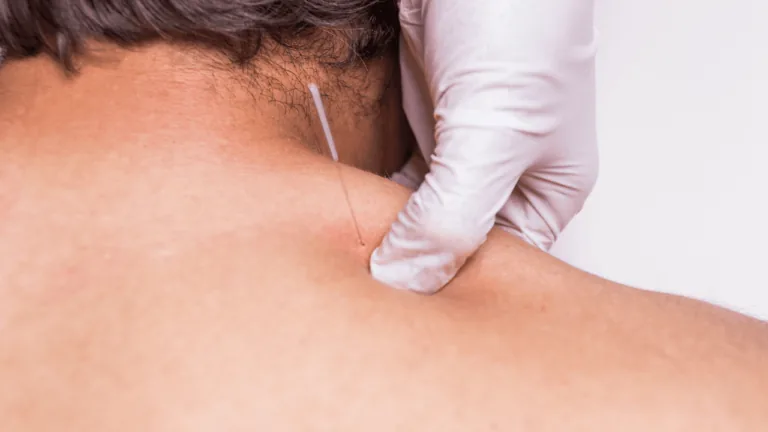
Close-up of a dry needling needle being placed into the upper trapezius muscle at the base of the neck
Dry needling for trigger points, where it is appropriate.
How we treat it

Upper cervical assessment covering joint mobility at C1–C3, suboccipital tension, temporomandibular joint function, and postural load — plus your actual driving position, which for most Officer patients is the single highest-yield thing we change. Seat rake, headrest position, and how far you are reaching for the wheel remove a large amount of sustained load twice a day, permanently and for no ongoing effort. Hands-on treatment combines targeted mobilisation of the upper cervical spine, suboccipital soft tissue release, and postural retraining. Most cervicogenic and tension headaches improve meaningfully within 4–6 sessions.

Ready to get started?

Same-week appointments available. Initial consult 60 min · $149 · HICAPS on-site.

Common questions

FAQ: headache treatment officer

How far is your clinic from Officer?
We're at 5/6-8 Langmore Lane, Berwick — approximately 5 minutes from Officer and the Arena estate via the Princes Freeway.
My headaches are worse by Friday and gone by Sunday. What does that mean?
That weekly pattern is one of the more useful diagnostic clues we get, and it points strongly at a postural or driving driver rather than anything sinister. Something you do Monday to Friday is loading your neck cumulatively — for most Officer patients it is the commute. It usually responds well, and quickly.
Can osteopathy really help headaches?
For cervicogenic and tension-type headaches, yes — these have musculoskeletal drivers that respond well to manual therapy and targeted exercise. For migraine it is more nuanced: we can often reduce frequency by treating a cervical trigger, but osteopathy is not a migraine cure and we will not claim otherwise.
When should a headache be checked medically first?
See a doctor urgently rather than booking with us for a sudden severe headache unlike any you have had before, a headache with fever and neck stiffness, one following a significant head knock, or any headache with vision loss, confusion, weakness or slurred speech. These are uncommon but need medical assessment, not manual therapy.
How many sessions will I need?
Most cervicogenic and tension headache patients see meaningful improvement within 4–6 sessions. Migraine management takes longer and needs a broader approach.
Do I need a referral?
No. Book directly online. DVA, WorkCover, and Medicare EPC referrals are also welcome.

Seen enough?
Let's fix it.

Book an initial assessment in Berwick. Same-week availability most weeks.

Same-week appointments availableCall

Tweaks