Neck strain from lifting weights: causes and recovery
A sudden sharp pain or tightness in the neck during or after a gym session is common. It often happens mid-set on shrugs, overhead press or deadlifts, or shows up the next morning. Steven lifts and sees this regularly. It's usually a muscle or joint strain that settles well.
Which exercises most often strain the neck?
Heavy shrugs, deadlifts, overhead press, pull-ups, upright rows and barbell squats are the usual ones. So are exercises where you crane your head, such as looking up in a squat or deadlift, jutting your chin forward on a bench press, or straining to finish a rep. Sit-ups with your hands pulling on your head and heavy carries can also do it.
Why did I strain my neck lifting?
The muscles running from the neck to the shoulder blade, particularly the upper trapezius and levator scapulae, work hard to stabilise your head and shoulders under load. Straining to finish a rep, holding your breath and tensing your neck, a sudden jerk, or lifting on little sleep can overload them or irritate a small joint in the neck. Fatigue and a jump in training volume are common factors.
What does a neck strain feel like?
Usually a sharp or pulling pain on one side of the neck or towards the shoulder blade, with stiffness and pain when turning or tilting your head. It can be very stiff the next morning. Muscle spasm is common, and it may ache into the top of the shoulder.
How do I know if it's a pinched nerve?
A strain stays in the neck, shoulder and shoulder blade area. Pain that travels down the arm, pins and needles or numbness in the hand or fingers, or weakness in the arm suggest an irritated nerve and should be assessed.
See our post on pinched nerves in the neck.
What should I do for a neck strain?
Keep it gently moving rather than holding it still. Turn, tilt and nod within a comfortable range several times a day. Heat helps most people with spasm. Simple pain relief may help; ask your pharmacist. Avoid a collar, and avoid forcing stretches into sharp pain.
How long does a neck strain take to heal?
Most gym-related neck strains improve substantially within a few days to two weeks. Acute neck pain in general doesn't always clear completely by itself: a review found average pain roughly halved over about six weeks, but some people still had symptoms at 12 months (Hush et al., Archives of Physical Medicine and Rehabilitation, 2011). If yours isn't clearly improving after a week or two, get it assessed.
Can I keep training with a neck strain?
Usually, with changes. Lower-body machines, walking, cycling and exercises that don't load the neck are fine. For a week or two, avoid heavy shrugs, overhead pressing, heavy barbell squats and deadlifts, and anything that reproduces the pain. Reintroduce them with lighter loads once you can turn your head comfortably.
How should I position my head when lifting?
Keep your neck in a neutral, relaxed position in line with your spine. In squats and deadlifts, look at a spot on the floor a couple of metres ahead rather than up at the ceiling. On bench press, keep your head resting on the bench. On overhead presses, move your head back slightly to let the bar pass rather than jutting your chin.
What exercises help prevent neck strains?
Strength and endurance in the neck and upper back help. A Cochrane review found strengthening exercises for the neck, shoulders and shoulder blade muscles may reduce pain and improve function in people with chronic neck pain, while stretching alone wasn't expected to help (Gross et al., Cochrane, 2015). Rows, face pulls, Y raises, chin nods and gentle neck resistance exercises are good options.
Can an osteopath help a neck strain?
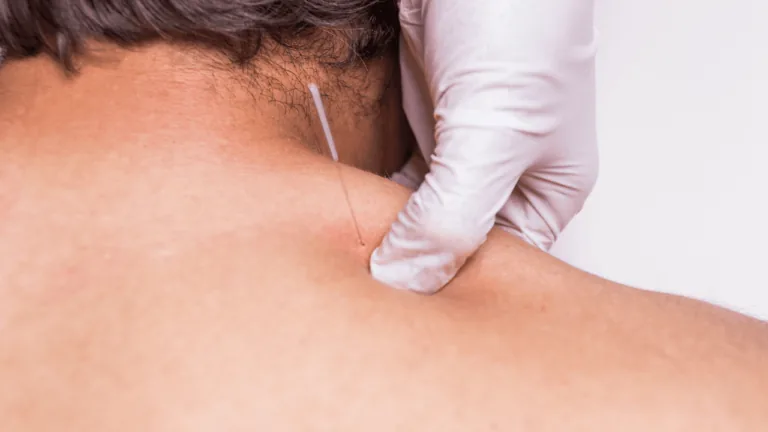
Yes. We assess the neck, check for nerve involvement, and use hands-on treatment, and sometimes dry needling, to ease pain and spasm and restore movement. We'll also advise on training changes and how to build back to your usual lifts.
Should I train my neck directly?
For most lifters, direct neck work isn't essential, but it can help if you get repeated neck strains or play contact or grappling sports. Start with gentle isometric holds, pressing your head into your hand in each direction, and progress slowly. Avoid heavy neck bridges unless you've built up to them.
When should a neck injury from lifting be checked urgently?
Call 000 for a sudden, severe headache during a heavy lift, especially with neck stiffness, vomiting, confusion, vision changes or weakness. Seek urgent care for severe neck pain after a fall or dropped bar, numbness or weakness in the arms or legs, or difficulty walking.
See our posts on waking with a stiff neck and our neck pain guide. Book an assessment at our Berwick clinic. A 60-minute initial consultation is $149, with no referral needed and HICAPS on-site.
Sources
Book an initial consultation at RISE Sports & Spinal in Berwick. Clear diagnosis, hands-on treatment, and a plan that actually gets you better.
Related articles