Knee pain going down stairs: why it happens and what helps
If your knees complain on the stairs, especially on the way down, you're in good company. Stairs are one of the first places knee problems show up, because they load the front of the knee more than almost any other everyday activity.
Why do my knees hurt going down stairs?
Going down, your thigh muscles work to lower your body weight while the knee is bent, which presses the kneecap firmly into its groove on the thigh bone. If the joint behind the kneecap is sensitive, that's when you feel it. Going up loads the same area but in a less demanding way.
What is the most common cause?
In younger and active adults, patellofemoral pain: an ache around or behind the kneecap that's worse with stairs, squatting, running and sitting for long periods with the knees bent. In people over about 50, osteoarthritis of the kneecap joint or the main knee joint becomes more common.
See our posts on runner's knee and knee osteoarthritis.
Why is going down worse than going up?
Lowering yourself requires the quadriceps to work while lengthening, which produces high forces across the kneecap joint, and you land on a bent knee with each step. Weakness in the thigh and hip muscles makes this harder to control.
What other problems cause stair pain?
Patellar tendon pain, felt just below the kneecap. Meniscus irritation, usually felt on the inner or outer joint line, sometimes with catching. Irritation of the fat pad below the kneecap. Pain on the outside of the knee from the ITB in runners.
What is the best treatment?
Exercise. An international consensus statement recommends exercise therapy for patellofemoral pain, particularly a combination of hip and knee strengthening, and advises against relying on knee mobilisation alone (Collins et al., British Journal of Sports Medicine, 2018). The same approach helps most people with early kneecap arthritis.
What exercises help knee pain on stairs?
Sit-to-stands from a chair, wall sits or partial squats within a comfortable range, step-ups onto a low step, bridges, side-lying leg raises and band walks for the hips, and calf raises. Start with a level that causes little pain and progress the depth, step height and load over weeks.
How should I use the stairs in the meantime?
Use the handrail. Lead with the good leg going up and the sore leg going down ('up with the good, down with the bad'). Take your time, and put your whole foot on each step. Going down sideways or backwards can ease the load during a flare.
Does my knee grinding on the stairs mean damage?
Not necessarily. Grinding or crackling under the kneecap is very common, and a study found it had no relationship with pain severity or function in women with kneecap pain (de Oliveira Silva et al., Physical Therapy in Sport, 2018).
See our post on clicking knees.
Should I avoid stairs?
Not completely. Reducing unnecessary trips during a flare is sensible, but stairs are part of life and a useful strengthening exercise. The aim is to build your knees back up to cope with them.
Do knee braces or taping help?
Taping or a sleeve that supports the kneecap can reduce pain in the short term and is recommended as an option alongside exercise in the consensus statement. Neither replaces strengthening.
Does weight make a difference?
Yes. Each kilogram of body weight is multiplied through the knee on stairs. For people above a healthy weight with knee arthritis, modest weight loss combined with exercise reduces pain.
See our post on body weight and knee arthritis.
How long does it take to improve?
Most people notice stairs becoming easier within four to six weeks of consistent strengthening, with further improvement over three months.
Why do my knees hurt on stairs but not when walking?
Walking on the flat keeps the knee fairly straight, so the kneecap joint carries little load. Stairs, hills, squatting and getting out of low chairs all bend the knee under body weight, which is when a sensitive kneecap joint complains. Pain that's specific to these activities points strongly to the front of the knee.
Is walking downhill the same problem?
Yes. Walking or running downhill loads the knee in the same way as descending stairs. Shorter steps, a slower pace and, on steep ground, walking poles reduce the load while you build strength.
Can I still exercise?
Yes. Cycling, swimming and walking on the flat are usually comfortable and keep you fit. Strength work within a pain-free range is the treatment, so keep that going even when stairs are sore.
How can an osteopath help?
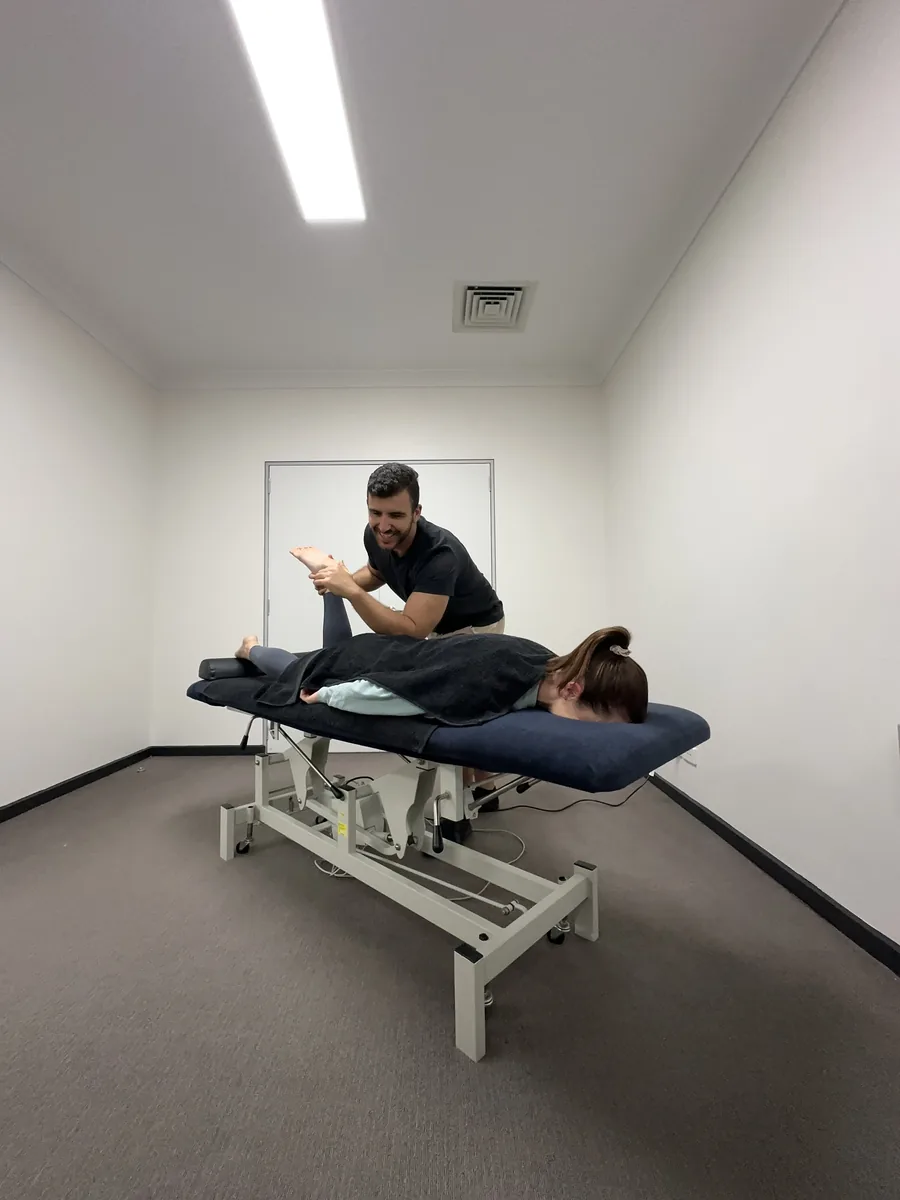
We work out which part of the knee is involved, check the hips, ankles and feet, treat hands-on to ease pain, and build a progressive program with stairs as one of the goals.
When should it be checked?
Book in if stair pain isn't improving after a few weeks. See a doctor promptly for a knee that's swollen, hot or red, locks, gives way on the stairs, or after a fall.
See our knee and ankle pain guide. Book an assessment at our Berwick clinic. A 60-minute initial consultation is $149, with no referral needed and HICAPS on-site.
Sources
Book an initial consultation at RISE Sports & Spinal in Berwick. Clear diagnosis, hands-on treatment, and a plan that actually gets you better.
Related articles