Scheuermann's disease: a rounded upper back in teenagers
Many teenagers slouch, and most of the time it's just posture. But a rounded upper back that doesn't straighten when your teen tries to stand tall, sometimes with mid-back pain, can be Scheuermann's disease. Despite the name, it's a growth-related condition rather than a disease in the usual sense.
What is Scheuermann's disease?
It's a condition of the growing spine in which several vertebrae become slightly wedge-shaped, increasing the forward curve (kyphosis) of the upper or mid back. A review describes it as a condition of the growth plates of the vertebrae, probably due to repetitive strain on growth cartilage in people with a genetic predisposition (Palazzo et al., Joint Bone Spine, 2014). It usually appears during the growth spurt, between about 10 and 15 years.
What are the signs of Scheuermann's disease?
A rounded upper back that looks more angular than a normal slouch, and that doesn't flatten when the teenager stands up straight or lies face down. It's often most obvious when bending forward, seen from the side. There may be aching in the mid-back, particularly after sitting, standing or sport, tight hamstrings, and a forward head position.
How is it different from poor posture?
Postural rounding is flexible: it corrects when the teenager straightens up or lies down. In Scheuermann's, the curve is stiffer and remains even when they try to correct it, because the shape of the vertebrae has changed. An X-ray confirms it.
Does Scheuermann's disease cause pain?
It can, but not always. Some teenagers have no pain and are only noticed because of their posture. The same review notes that the lower (lumbar) form is probably as common as the thoracic form and may be more painful. Pain is typically an ache with activity or prolonged sitting that eases with rest.
How is Scheuermann's disease diagnosed?
By your GP or a specialist, with a physical examination and a standing X-ray of the spine. If we suspect it, we'll refer you to your GP for imaging. X-rays also show the size of the curve, which guides treatment.
How is it treated?
The review states that first-line treatment is non-surgical and based on rehabilitation. For most teenagers with mild to moderate curves, that means exercise, staying active, and monitoring during growth. Bracing may be recommended by a specialist for larger curves while the teenager is still growing. Surgery is uncommon and reserved for severe curves or pain that doesn't respond to other treatment.
What exercises help?
A typical program includes exercises to strengthen the upper back and shoulder blade muscles, such as rows, prone back extensions and Y raises, mobility for the upper back, and stretches for tight hamstrings and chest muscles. Trunk strength and general fitness matter too. Consistency over months is what counts.
Can my teenager keep playing sport?
In most cases, yes, and staying active is encouraged. Sport and exercise help with strength, fitness and wellbeing. If pain is flaring, load may need to be adjusted for a while, and activities with very heavy spinal loading may be modified on specialist advice.
Will it get worse?
The curve can progress during growth, which is why it's monitored. Once growth finishes, it usually stabilises. Many adults with mild Scheuermann's live normally, though some have a more rounded upper back and occasional back ache.
Can an osteopath help?
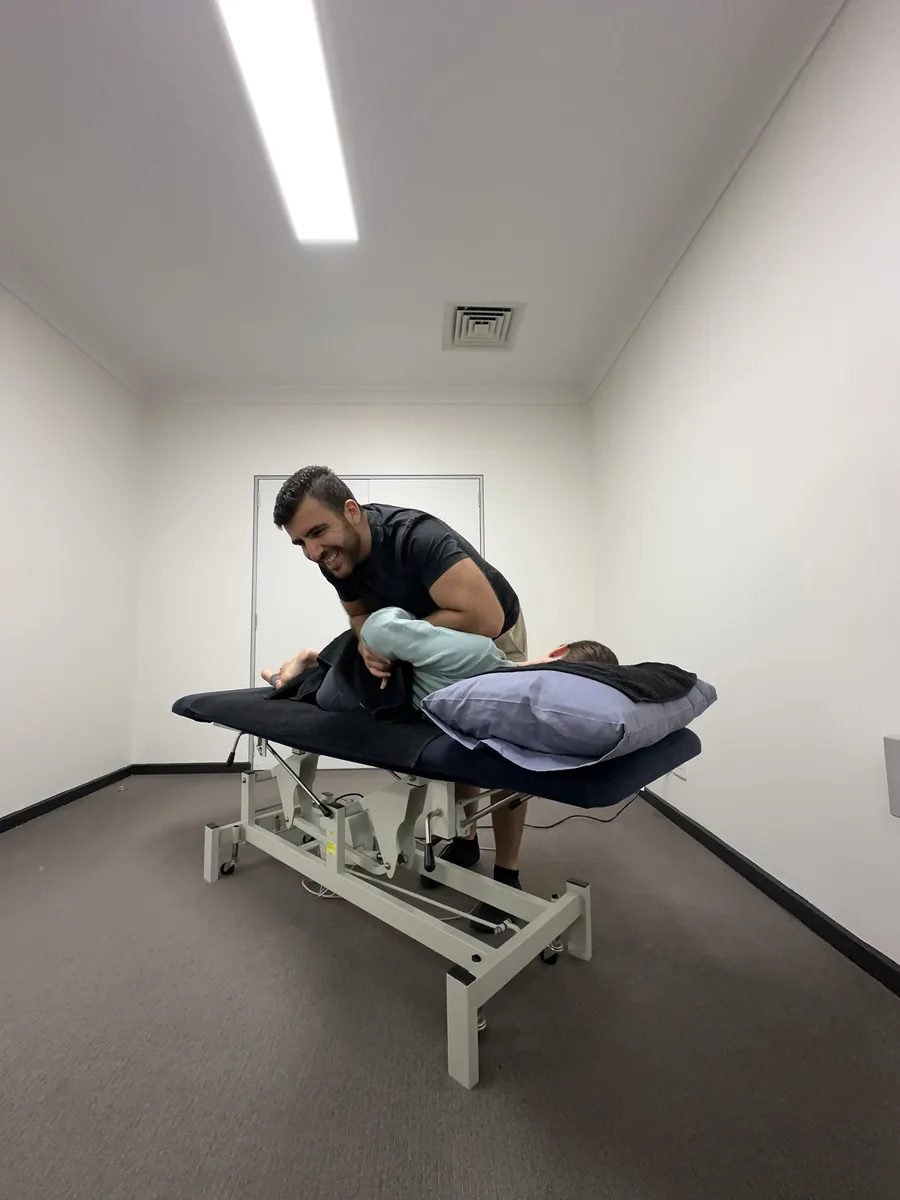
We can't change the shape of the vertebrae, but we can help with pain, stiffness and strength. Treatment combines gentle hands-on work for the mid-back and surrounding muscles with an exercise program suited to a teenager, and advice on school bags, study set-up and sport. We work alongside your GP or specialist.
Is Scheuermann's disease caused by slouching or heavy school bags?
No. Slouching, phones and school bags don't cause the vertebrae to change shape. Scheuermann's is related to how the spine grows. Good habits still help with comfort, but parents and teenagers shouldn't blame themselves for the condition.
Can adults have Scheuermann's disease?
Yes. Adults who had it as teenagers keep the vertebral shape, and some first learn about it from an X-ray taken for another reason. Many have no symptoms. For those with mid-back ache or stiffness, strengthening, mobility work and hands-on treatment can help.
When should a teenager's back be checked by a doctor?
See your GP for a curve that seems to be increasing, a rounded back that doesn't straighten, or back pain lasting more than a few weeks. See a doctor promptly for back pain at night, pain with fever or feeling unwell, weight loss, numbness, weakness, or changes in bladder or bowel control. Persistent back pain in a child or teenager should always be assessed.
See our posts on scoliosis in children and teens and school bags and back pain, or our upper back pain guide. Book an assessment at our Berwick clinic. A 60-minute initial consultation is $149, with no referral needed and HICAPS on-site.
Sources
Palazzo C, et al. Scheuermann's disease: an update. Joint Bone Spine, 2014.
Book an initial consultation at RISE Sports & Spinal in Berwick. Clear diagnosis, hands-on treatment, and a plan that actually gets you better.
Related articles